
Short answer: yes, it’s normal for one eye to be a little stronger than the other. Most of us have a small difference in prescription between our eyes. It even has a name, anisometropia, and the brain is good at quietly blending the two images so you never notice. A big difference, or one that shows up suddenly, is a different story. That can bring headaches and eye strain, and in a child it can lead to a lazy eye, so it’s worth getting checked.
Below we’ll go through why one eye ends up weaker, when the gap actually matters, the symptoms that shouldn’t wait, what happens in the exam, and how glasses or contacts bring both eyes back into step.
Is it normal for one eye to see better than the other?
Cover one eye, then the other. If one looks a touch sharper, welcome to the majority. Each eye has its own shape, its own lens and its own prescription, and the two almost never match exactly. That’s the normal range.
What we pay attention to is the size of the gap and whether it’s new. A difference you’ve always had and that doesn’t bother you needs nothing more than your regular exam. A difference that appeared recently, or that comes with headaches, double vision or trouble judging distance, should be looked at soon.
Why is one eye worse than the other? Anisometropia, explained
The usual reason is anisometropia: each eye has a different refractive error. One might be more nearsighted, more farsighted, or carry more astigmatism than the other. Because they focus light differently, one image arrives at the brain crisper than the other. On your prescription it shows up as different numbers for OD (right eye) and OS (left eye).
Anisometropia is usually there from childhood and often runs in families. It isn’t a disease. It’s a mismatch, and glasses or contacts fix it by giving each eye its own lens power. As a rule of thumb, a difference of about one diopter or more between the eyes is worth correcting so they can work together comfortably. If you’re not sure how sharpness is measured, our explainer on what 20/20 vision means covers it.
Common causes of uneven vision
A different prescription in each eye is the big one, but a few everyday things can also make one eye feel like it’s lagging:
- Different refractive errors in each eye (anisometropia), by far the most common cause
- An old or slightly wrong prescription in one lens
- Screen fatigue, which tends to hit the dominant eye first
- Dry eye, which can blur one eye more than the other as the day goes on
- A scratched, smudged or badly fitted lens on one side
- A lazy eye (amblyopia) from childhood that was never treated
Left eye weaker than right, or the other way round: does the side matter?
No. Whether it’s the left or the right eye makes no difference to what’s going on or how we treat it. What matters is how big the gap is and whether it came on suddenly. Anything over about a diopter of difference is worth correcting so both eyes pull together.
Most people also have a dominant eye, the one the brain prefers for aiming and fine detail. It’s not necessarily the sharper eye, which surprises people. We regularly meet customers whose “good eye” turns out to be the one with the stronger prescription.
How the brain compensates, and why that’s a problem
When one eye sends a blurrier picture, the brain simply leans on the sharper one. In adults this can go unnoticed for years. It isn’t free, though: depth perception suffers, keeping the two images fused takes effort, and that effort tends to show up as headaches or tired eyes by evening. A lot of people only realise how hard they were working once their prescription is balanced.
For children the stakes are higher. If the brain ignores a blurry eye during the years when vision is still developing, that eye can end up permanently weaker. That’s amblyopia, and it’s the reason we push for children’s eye exams even when a child never complains about anything.
Medical conditions that can cause uneven vision
Less often, a gap between the eyes is a sign of something happening in one eye rather than a prescription mismatch. These need a proper look:
- A cataract forming in one eye before the other
- Keratoconus, where the cornea thins and bulges, usually more in one eye
- Macular degeneration or a macular hole affecting central vision on one side
- A retinal tear or detachment, which brings sudden shadows, flashes or a curtain across part of your vision
- Optic neuritis or other optic nerve problems, which can dim vision and colour in one eye
- Glaucoma, which can affect the eyes unevenly and has no early symptoms
- Diabetic retinopathy, which can progress at different speeds in each eye
Symptoms you shouldn’t ignore
Book an exam promptly if you notice any of these. For the first two, seek same-day care.
- A sudden change in vision in one eye
- New flashes, floaters, or a shadow or curtain in your vision
- Double vision or ghosting
- Headaches or eye strain after reading or screen time
- Pain, redness or light sensitivity in one eye
- A child who squints, tilts their head or covers one eye
How an eye exam finds the cause
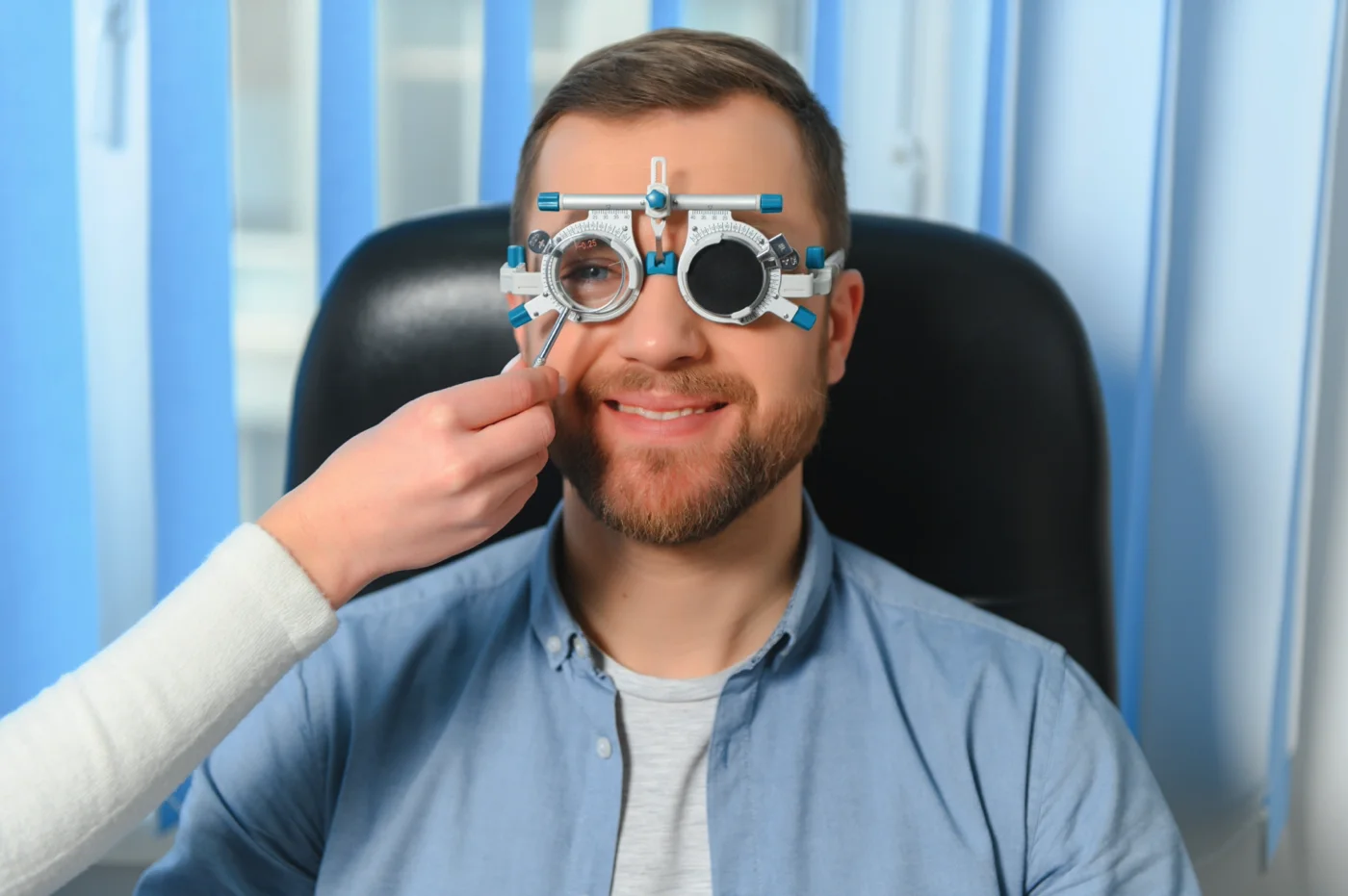
A comprehensive exam tests each eye on its own. The chart shows how sharp each eye is. Refraction finds the exact lens power each one needs. Then we look at the cornea, lens, retina and optic nerve to rule out the medical causes above, and check eye pressure and how well the eyes work as a pair.
At Eyeglass Factory, independent doctors of optometry are right next door to every store. Already have a prescription? We’ll use it. Don’t have it to hand? We’ll call your doctor. We’ve also written up what an eye exam costs and what’s included, if you’d like to know before you come in.
How uneven vision is treated
For anisometropia, the fix is a prescription that gives each eye its own lens power. Glasses handle small and moderate differences well. For bigger gaps, contact lenses are often more comfortable: because they sit on the eye, they avoid the slight size difference between the two images that thick, unequal spectacle lenses can create.
When a medical condition is behind it, the treatment is for that condition, whether that’s cataract surgery, managing keratoconus or prompt care for a retinal problem. The earlier the cause is found, the more options you have.
Children and adults: what’s different
In children, a gap between the eyes is the leading cause of amblyopia, and it’s most treatable before the age of about seven or eight. Treatment usually pairs glasses with patching or drops that make the weaker eye do some work. Kids rarely report the problem themselves, so a first exam somewhere between three and five, and another before school starts, is the safety net. If cost is a worry, our free glasses for kids program is there for exactly that reason.
In adults the goal is comfort and depth perception rather than development. Once the prescription is balanced, headaches and strain usually settle within a week or two of wearing the new lenses full time.
Can it get worse over time?
A stable difference tends to stay stable, though both eyes drift with age, especially after forty when near focus starts to slip. A gap that widens quickly, or a brand-new one in adulthood, is the cue to look for a medical cause rather than assume your prescription has simply moved.
When to see an eye care professional
Come in if the difference between your eyes is new, is getting worse, gives you headaches or double vision, or involves a child. Everyone else: a yearly exam is enough to keep track of a stable difference and catch changes early.
Frequently asked questions
Is it normal for one eye to be stronger than the other?
Yes. Small differences are common and usually harmless. Large or sudden differences need an eye exam.
Why is one eye worse than the other?
Usually a different prescription in each eye, called anisometropia. Less often, injury, cataract or another eye condition.
Do both eyes have the same vision?
Rarely exactly. Most people have a slightly different prescription in each eye.
Can glasses fix uneven vision?
Yes, in most cases. Each lens is made to its own prescription so both eyes see clearly together.
Is it normal to see better out of one eye at night?
Mild differences are common. If it’s new or getting worse, book an eye exam.
When should I see an eye doctor about uneven vision?
Any sudden change, double vision, pain, or a child who squints or tilts their head.
The short version
A slightly weaker eye is normal and easy to correct. What you don’t want to do is let your brain quietly cover for it for years, or assume a child will grow out of it. One proper exam tells you whether it’s a simple prescription mismatch or something that needs care, and most of the time a well-balanced pair of glasses is all it takes.
One eye pulling its weight more than the other?
Let’s find out why. Book a comprehensive eye exam at Eyeglass Factory, with independent doctors of optometry next door to every store.
Santa Barbara: 1 S Milpas St. Call or text 805-965-9000.
Ventura: Call or text 805-642-2222.
Camarillo: Call or text 805-987-8600.
Buy any complete pair and the second pair is free. Most prescriptions are made in our in-store lab in about an hour, and we accept most insurance, including MES and Cottage Health Systems.
Schedule your eye exam online, or just walk in.